Search site
Contact
E-mail: mda07lch@shef.ac.uk
Reverse Genetic Techniques
Site specific mutagenesis: creating a mutation to alter or remove the function of a gene can be achieved in many different ways.
Gene Knockout:
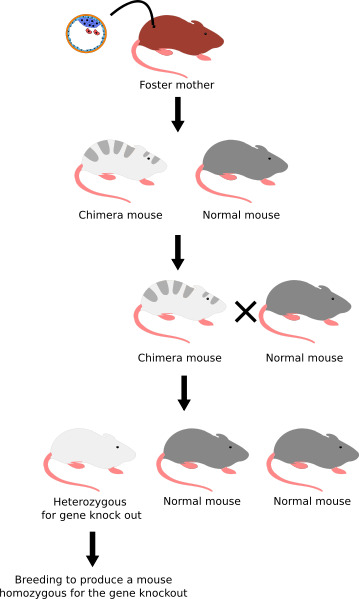 The first step in gene knockout is to take your gene of interest from a library and create a similar sequence of DNA that prevents the gene from functioning.
Stem cells from a mouse with one coat colour (e.g. white) are taken and the new sequnce of DNA is introduced to these cells. Homologous recombination of this gene does not occur in every cell and so a marker attached to the new DNA sequence is required to visualise which cells have had the gene knocked out. This marker can take the form of a sequence giving resistance to a toxin or a fluorescent tag and allows for easy identification of cells which have had the gene knocked out.
Once it has been confirmed that the gene of interest has been knocked out in a cell, the cell is reintroduced into a blastocyst from a mouse with a different coloured coat (e.g. grey). This blastocyst is then mothered by a foster mother. The offspring contain a mix of cells, some with the gene knocked out, others with the original gene still present and therefore have a mosaic coat of white and grey. These mice need to be crossed with wild type grey mice in order for a completely white mouse to be formed. This mouse is heterozygous for the mutation in the gene of interest and can be bred to produce homozygous offspring which show the effects of removing the function of the gene.
Image courtesy of wikimedia commons under creative commons attribution 3.0 unported license.
Gene silencing by RNAi
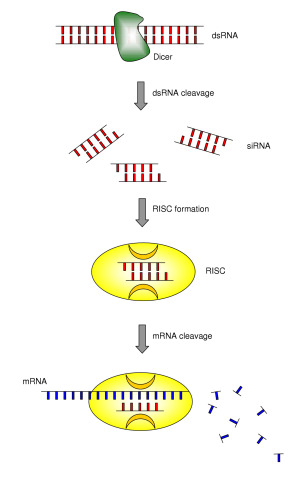 dsRNA is injected into cells where it is cleaved into 21-23 nucleotide lengths (siRNAs). The siRNA form a RNA-induced splicing complex (RISC) and bind to lengths of endogenous mRNA with complementary bases to the siRNA. This leads to the endogenous mRNA being degraded by splicing into short nucleotide sequences, preventing the expression of the gene encoded for by the mRNA and showing the phenotype caused by loss of function of that gene.
Image courtesy of wikimedia commons under creative commons attribution 2.0 liscence.
Gene knockdown by Morpholinos
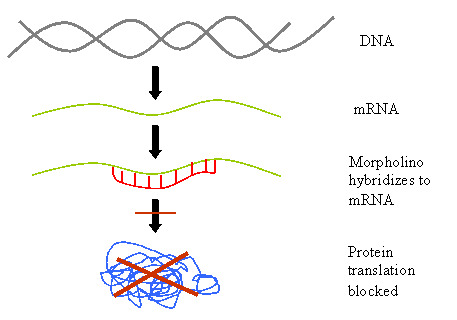
Morpholinos are small 25 base pair antisense molecules which bind to mRNA at the 5' end of the coding region preventing correct association of initiation complexes with the mRNA. This prevents the translation of the mRNA and therefore the expression of the gene it encodes for. The phenotype produced reveals the function of the knocked down gene.